
Introduction
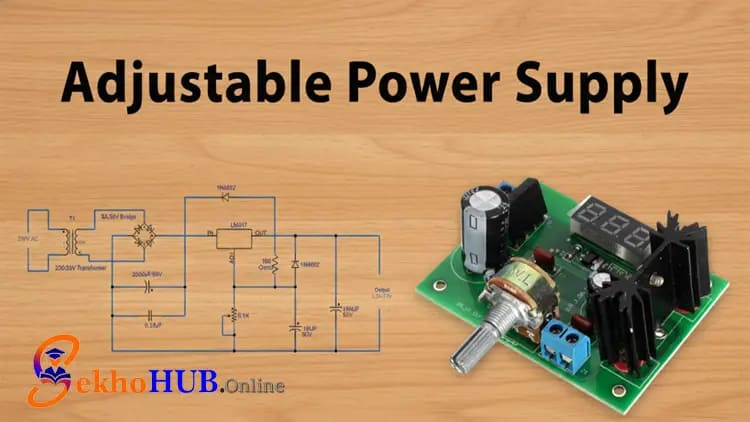
The Adjustable Power Supply using LM317 is a versatile solution for electronics enthusiasts and professionals alike. By using a linear regulator, this circuit delivers a stable adjustable voltage output suitable for testing and powering various devices. Its current limiting and circuit protection features make it safe for both beginners and experienced hobbyists.
Ideal for a bench power supply, this DIY project allows precise control over voltage levels. With simple components and an easy setup, building this power supply provides a hands-on understanding of DIY electronics fundamentals. Curious how to assemble it and achieve stable outputs?
Overview
An Adjustable Power Supply using LM317 provides flexibility for powering electronics projects. This voltage regulator IC allows output adjustment via a potentiometer while maintaining a steady voltage. Unlike fixed regulators like the 7805 alternative, the LM317 supports a wide input voltage range and can supply adequate current limiting for various loads.
Capacitors stabilize the regulated DC output, ensuring minimal ripple. This circuit is perfect for testing circuits, powering microcontrollers, and creating a reliable bench power supply circuit. Understanding electronic components like resistors, capacitors, and diodes is key to building a dependable setup.

Components Required
| S.no | Component | Value | Qty | Buy Link |
|---|---|---|---|---|
| 1 | Breadboard | – | 1 | Buy Here |
| 2 | Connecting Wires | – | 1 | Buy Here |
| 3 | Stepdown Transformer | 230/28V,3A,50 Hz | 1 | Buy Here |
| 4 | Voltage Regulator IC | LM317 | 1 | Buy Here |
| 5 | Bridge Rectifier Diode | 3A 50V | 1 | Buy Here |
| 6 | Diode | 1N4002 | 2 | Buy Here |
| 7 | Resistor | 100 ohms | 2 | Buy Here |
| 8 | Potentiometer | 5.1k | 1 | Buy Here |
| 9 | Electrolytic Capacitor | 220uF,100uF,10uF | 1,1,1 | Buy Here |
| 10 | Ceramic Capacitor | 0.33uF | 1 | Buy Here |
LM7805
The LM7805 is a fixed voltage voltage regulator IC that provides a stable 5V output from a higher input voltage. It offers protection against overload and thermal issues, making it reliable in a wide range of electronics projects. Compact and easy to use, it’s a go-to choice for beginners and advanced hobbyists alike. Curious how it differs from adjustable regulators and how it integrates into circuits? Learn more.
Circuit Diagram
Build Guide Step-by-Step
Step 1
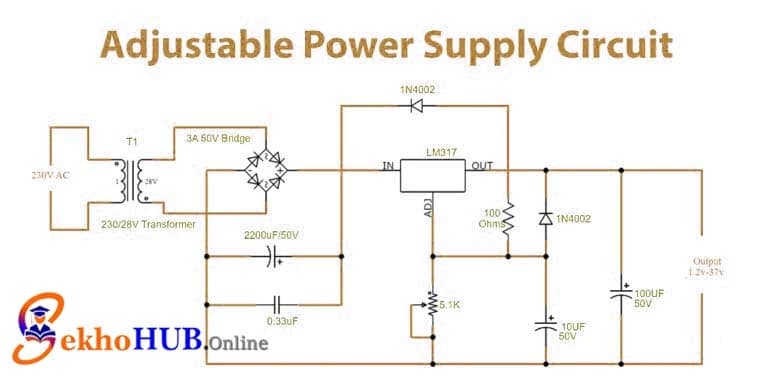
Connect the step-down transformer to the bridge rectifier input. Ensure proper AC to DC conversion.
Step 2
Connect the LM317 input to the rectified DC output. Place the input capacitor to stabilize voltage.
Step 3
Connect the adjustable potentiometer and resistors to the LM317 to set the desired adjustable voltage.
Step 4
Add the output capacitor between LM317 output and ground to reduce ripple.
Step 5
Test the voltage using a multimeter. Ensure current limiting works correctly and all connections are secure.
Step 6
Finalize the assembly on the breadboard or PCB. Your bench power supply is now ready for testing DIY electronics projects.
Applications
Powering microcontrollers and sensors
Electronics hobby projects
Testing circuits at various voltages
Small bench power supply for labs
Learning about linear regulator design and load regulation
FAQs
Q1: What is the maximum input voltage for LM317?
A1: Typically up to 40V DC.
Q2: Can LM317 provide current limiting?
A2: Yes, it has built-in current limiting for protection.
Q3: Difference between LM317 and LM7805?
A3: LM317 is adjustable, while LM7805 provides fixed 5V output.
Q4: Do I need a heat sink?
A4: Yes, for higher currents to prevent overheating.
Conclusion
The Adjustable Power Supply using LM317 is an essential project for electronics enthusiasts. It combines simplicity, safety, and versatility, making it ideal for DIY electronics, testing circuits, and powering devices at variable DC output. Understanding the linear regulator operation and proper circuit protection ensures reliable performance.