
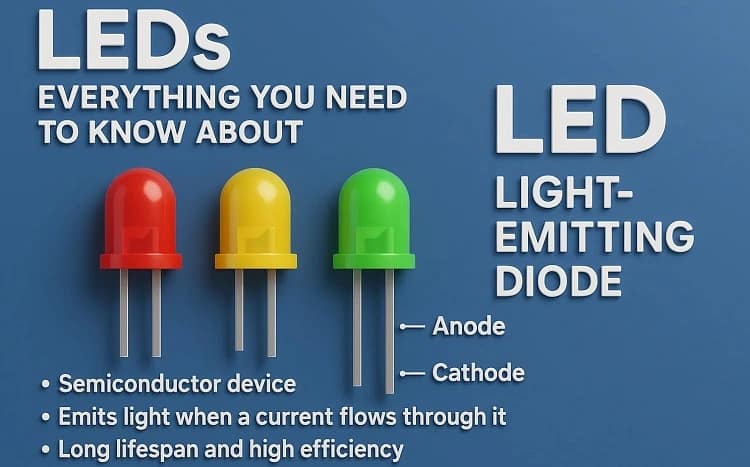
LEDs (Light-Emitting Diodes) have become an essential part of modern electronics, appearing in everything from smart devices to automotive lighting and home appliances. These tiny semiconductor components convert current into visible light, offering energy efficiency and long lifespan compared to traditional bulbs.
Understanding how LEDs emit light and their unique characteristics, such as forward voltage LED and LED brightness control, is vital for hobbyists, engineers, and DIY enthusiasts. Whether you are working on an Arduino LED blink project, designing LED circuits, or exploring advanced OLED display technology, learning the fundamentals of LEDs (Light-Emitting Diodes) ensures safer, more effective, and visually appealing electronic designs for real-world applications.

What is an LED?
A LED (Light-emitting diode) explained is a device that produces light using a semiconductor die material. Inside each LED, there are two main parts: the anode and cathode. When the forward current flows from the anode to cathode, electrons recombine with holes, releasing energy in the form of photons. This simple principle is why LEDs are brighter and more energy-efficient than incandescent bulbs. Understanding LED polarity explanation is critical because reversing connections will prevent the LED from lighting, although it typically won’t damage the device.
LEDs come in various colors, including red, green, blue, and white. The color depends on the semiconductor compound used, such as Gallium arsenide, Gallium phosphide, or Aluminum gallium indium phosphide. A clear understanding of LED color wavelength helps in applications like traffic lights, automotive lighting, or display panels. Many hobbyists start with an Arduino LED blink project to learn how LEDs emit light and how forward voltage of LED affects brightness.

LED Working Principle
The LED working principle is based on electroluminescence. When a current passes through a diode, it flows from the anode to the cathode, and the semiconductor emits photons. This process is highly efficient compared to traditional bulbs because less energy is wasted as heat. How LEDs emit light and their brightness depends on current-limiting resistor for LED and LED forward current rating, which ensures that the LED operates safely without burning out.
Another aspect is LED brightness control. By adjusting PWM signals, you can change the duty cycle, making LEDs brighter or dimmer without affecting their lifespan. This method is widely used in OLED screen technology and RGB LED color mixing setups. Understanding LED I-V characteristics is essential for safe and effective design, especially in circuits where multiple LEDs are connected in series or parallel.

Types of LEDs (Light-Emitting Diodes)
LEDs exist in a variety of types. Single-color LEDs emit one color of light, while Bi-color and tri-color LED can emit two or three colors depending on the wiring. RGB LEDs combine red, green, and blue in a single package, allowing virtually any color to be created through RGB LED color mixing. Infrared LEDs emit light outside the visible spectrum and are widely used in Infrared LED communication devices such as remote controls and sensors.
SMD LEDs are surface-mounted and used in SMD LED for Arduino and other compact electronics. They are small, efficient, and come in different shapes and sizes. OLEDs or Organic LEDs differ from conventional LEDs because they use a conductive organic layer to produce light. OLED screen technology is common in high-end smartphones and displays. Each type has unique characteristics, advantages, and best use scenarios, making LED selection crucial for specific LED real-life applications.

Electrical Characteristics
LEDs have specific electrical characteristics that determine how they operate. Forward voltage LED varies with color; red LEDs need around 1.6V, while blue and white LEDs may require 3.0V or more. Current is equally important. Standard LEDs often operate at 20mA, and using a current-limiting resistor for LED protects the device from excess current. Incorrect voltage or current can shorten LED lifespan or destroy the component.
Connecting multiple LEDs requires careful calculation. Series connection sums the forward voltage, while parallel connection requires separate resistors for each LED. Tables help summarize typical values:
| LED Color | Forward Voltage (V) | Recommended Current (mA) |
|---|---|---|
| Red | 1.6 | 20 |
| Green | 1.9 | 20 |
| Blue | 2.4 | 20 |
| White | 3.5 | 20 |
| Infrared | 1.2 | 20 |
Understanding LED current-limiting calculation ensures circuits operate efficiently and safely.
LED Drivers and Control Circuits
Controlling LEDs beyond simple blinking requires LED driver circuit designs. Transistor-based drivers amplify signals to power multiple LEDs without damaging the microcontroller. IC drivers are popular in Arduino LED blink project setups because they simplify the design. Using PWM signals, you can dim LEDs or create dynamic lighting effects without wasting energy.
Advanced circuits also allow multi-colored LED displays to change colors smoothly. For example, RGB LED color mixing uses three separate PWM channels to adjust red, green, and blue intensity. LED flasher circuit designs are common in automotive and hobby projects, allowing sequences of LEDs to blink in patterns for visual effects.
Applications of LEDs
LED real-life applications are vast. Automotive lighting, including brake lights and dashboards, increasingly rely on LEDs because of their durability and low power consumption. Household devices, TVs, smartphones, and IoT devices also benefit from LEDs’ efficiency. Infrared LED uses are prominent in remote controls, security cameras, and sensors, enabling invisible communication.
LEDs are also popular in DIY and hobby electronics. Using LEDs in Arduino projects, hobbyists can create blinking lights, color-changing LEDs, and sequenced displays. Industrial applications, such as machine status indicators and signage, rely on robust LEDs with long lifespans and high brightness.
Advantages and Limitations of LEDs
The pros and cons of using an LED are important for any designer. Advantages include low energy consumption, long lifespan, and fast response times. LEDs are physically robust and generate minimal heat compared to incandescent bulbs. They can easily integrate into PWM LED dimming systems and can produce a wide range of colors, especially using RGB LED color mixing.
However, LEDs also have limitations. Single LEDs have low power output, requiring multiple units for high brightness. They rely on current-regulated supplies and proper LED series resistor selection. Some colored LEDs need different voltages, and overcurrent can burn them out. Safety precautions and proper design are essential to avoid failures.
Advanced LED Configurations
Advanced LED setups include multi-colored LED strips, OLED displays, and high-power industrial LEDs. RGB LED color mixing allows precise color creation for decorative lighting or visual indicators. OLED screen technology uses individual pixel control to produce vibrant, high-contrast displays. Some industrial designs integrate Infrared LED communication for automated devices and sensors.
High-power LEDs require careful LED driver circuit selection and heat management. Designers also experiment with laser LEDs for specialized applications. These advanced configurations push LED capabilities far beyond simple indicator lights, making them suitable for consumer electronics, automotive, and industrial systems.
Designing LED Circuits for Projects
Designing LED circuits requires understanding LED forward current rating and LED polarity explanation. Start by calculating series resistors based on forward voltage LED and supply voltage. Connect LEDs in series or parallel depending on your needs, ensuring that each LED receives proper current to prevent damage.
Microcontroller projects, especially Arduino LED blink project, require controlling PWM signals to vary brightness or create patterns. Experimenting with Bi-color and tri-color LED or RGB LED color mixing allows hobbyists to achieve sophisticated visual effects while learning about LED I-V characteristics and safety precautions.
Tools, Components, and Resources
Working with LEDs requires basic components such as resistors, capacitors, transistors, and ICs. Tools like soldering irons, breadboards, and multimeters are essential for testing circuits. Reliable sourcing of SMD LEDs, modules, and OLED displays ensures high-quality results. Online datasheets, tutorials, and simulators help beginners calculate LED current-limiting calculation and understand LED housing and casing for various applications. Knowing how to troubleshoot LEDs is also critical for long-lasting circuits.
FAQs
What do you mean by LEDs?
LEDs are small semiconductor devices that emit light when electric current flows through them.
Why are LEDs used?
They’re used because they save energy, last long, and produce bright, efficient light.
What is the function of the LED?
An LED’s function is to convert electrical energy into visible or infrared light.
What is the working principle of LED?
An LED works on electroluminescence, where electrons release energy as light when they cross a semiconductor junction.
Are LEDs AC or DC?
LEDs run on DC, but they can be used with AC using drivers or rectifier circuits.
What is a 100 watt bulb equal to in LED?
A 100-watt incandescent bulb is roughly equal to a 14–16 watt LED bulb.
Conclusion
LEDs have transformed modern lighting with their efficiency, long life, and versatility. From tiny indicators to high-power illumination systems, they offer reliable performance across countless applications. Understanding how LEDs work, how to choose the right components, and how to design safe circuits helps you build better projects and make smarter lighting decisions.
Whether you’re a hobbyist, a student, or an engineer, LEDs open the door to creative and energy-saving designs that fit almost every need.