
Introduction
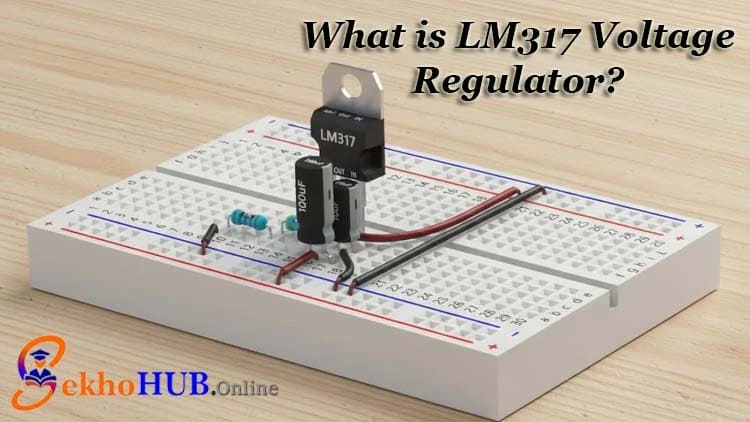
The LM317 voltage regulator is one of the most reliable components for creating stable DC outputs in electronics. This adjustable device allows users to fine-tune voltage levels with ease, making it a favorite in hobby and professional circuits. Engineers appreciate its predictable performance and built-in safety features, especially when designing power supplies or DIY tools.
The regulator ensures smooth output voltage adjustment and supports a broad range of operating conditions. In many small projects, the linear approach of LM317 offers simplicity without sacrificing performance. Its flexibility makes it suitable for lab prototypes, charger circuits, and sensor modules where stable DC is essential.
Overview
The LM317 voltage regulator operates as a three-terminal adjustable device that delivers clean and controlled DC output. It works by maintaining a stable voltage difference between the input and output, regardless of load variations. Designers often use it in bench supply builds and experimental circuits due to its wide adjustability and dependable response.
The IC includes internal protections like thermal shutdown, voltage ripple control, and current limiting feature, making it safe in demanding conditions. With only a few passive components such as a resistor, capacitor, and diode, this regulator can convert uncertain inputs into smooth, usable power. Its adaptability makes it ideal for sensor boards, chargers, and compact test equipment.
What is the LM317 Voltage Regulator?
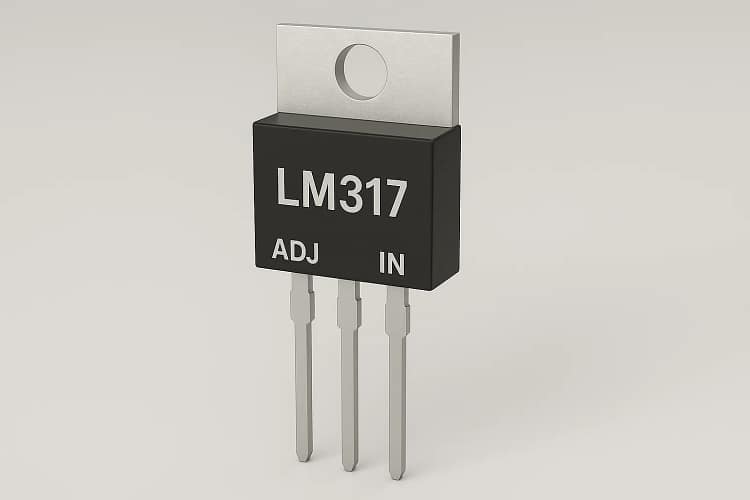
The LM317 is a three-terminal regulator IC designed to provide an adjustable voltage output ranging from 1.25V to 37V with load currents up to 1.5A. Unlike fixed regulators, it gives full control of the output using a simple two-resistor network. This IC is widely used in DC regulation circuits, DIY adjustable power supply builds, and compact LM317 adjustable voltage regulator circuit designs. Its built-in protections, including thermal shutdown, precision regulation, and overheating protection circuits, make it reliable for long-term use.
LM317 Voltage Regulator Pin Configuration
Understanding LM317 pin configuration is crucial for proper use:
Input (IN) – The unregulated input voltage enters through this pin.
Output (OUT) – The regulated output appears here.
Adjust (ADJ) – This pin allows electronic voltage control through a voltage divider.

The simplicity of these three pins allows easy integration into LM317 wiring and pinout details, enabling users to build stable supplies for small or medium-power circuits.
How the LM317 Voltage Regulator Works
The LM317 works as a linear on-board IC that maintains a 1.25V difference between its output and adjust pin. This difference forms a voltage reference, and by adding two resistor values, you can configure the desired output level.
Key working concepts include:
input to output difference determines internal dissipation
dropout voltage affects minimum usable input
regulator stability depends on capacitors
LM317 constant current circuit guide configurations use a sense resistor
current limiting feature protects against overload
Because it operates as a linear regulator, it wastes power as heat, so a heat-sink is often required depending on LM317 power dissipation.
Applications
The LM317 supports a wide range of LM317 applications, such as:
Step-down DC regulator using LM317
LM317 transformer power supply builds
Battery chargers
Adjustable bench power supplies
LED drivers
Constant current source using LM317
Sensor-based regulated supplies
Precision analog circuits requiring low-noise analog regulation
Automotive voltage stabilizers
Smart modules using LM317 adjustable module boards
Its versatility makes it ideal for students, professionals, and DIY enthusiasts.
Advantages of LM317
Wide voltage adjustment range
Built-in current limiting feature
Internal thermal shutdown increases component reliability
Easy to implement LM317 schematic designs
Works well in DC power supply design
Reliable regulator stability
Safer than using discrete transistor regulator alternative circuits
Greater flexibility than LM7805, explained in LM317 vs LM7805 comparison
Limitations
Lower efficiency compared to switching regulators
Requires adequate heat-sink for high power dissipation
Higher dropout voltage than low-dropout regulators
Output limited to LM317 1.5A regulator rating
Not suitable for high-current or high-efficiency supplies
Heat generation limits its use in compact spaces
LM317 Calculation Examples
1. LM317 Output Voltage Calculation
Using the LM317 formula Vout:
Vout = 1.25 × (1 + R2/R1) + (Iadj × R2)
In most designs, Iadj is negligible.
Example:
R1 = 240Ω, R2 = 1kΩ
Vout ≈ 1.25 × (1 + 1000/240)
Vout ≈ 6.46V
2. Constant Current Configuration
Using:
I = 1.25 / R
For LED driving:
If R = 10Ω
I ≈ 1.25 / 10 = 125mA
FAQs
What is LM317 used for?
It regulates voltage for power supplies, chargers, and constant-current circuits.
What is the difference between LM317 and 7805?
LM317 is adjustable, while 7805 gives a fixed 5V output.
What is the purpose of a voltage regulator?
It maintains a stable output despite load or input variations.
Is LM317 an IC?
Yes, it is a linear three-terminal IC designed for adjustable regulation.
What are the disadvantages of using LM317?
Lower efficiency, heat generation, and limited current output.
How does a 3-terminal voltage regulator work?
It controls the output voltage adjustment through a reference and internal feedback.
Conclusion
The LM317 voltage regulator is a dependable choice for engineers and hobbyists needing flexible voltage control. Its straightforward design, reliable protection features, and ability to function in countless LM317 application circuits make it a staple in modern electronics. Whether used in DIY adjustable power supply projects, bench power supply project builds, or precision analog designs, the LM317 remains one of the most respected regulators in the field. With correct configuration, proper heat-sink requirement for LM317, and attention to LM317 load current calculation, this regulator continues to deliver consistent performance across a wide range of applications.